
Workshop Electrical Panel Planner: Size Your Shop's Circuits Before You Build
Use our free interactive tool to map out every circuit in your metal shop — outlets, lighting, welders, compressors — and get an instant panel size recommendation.
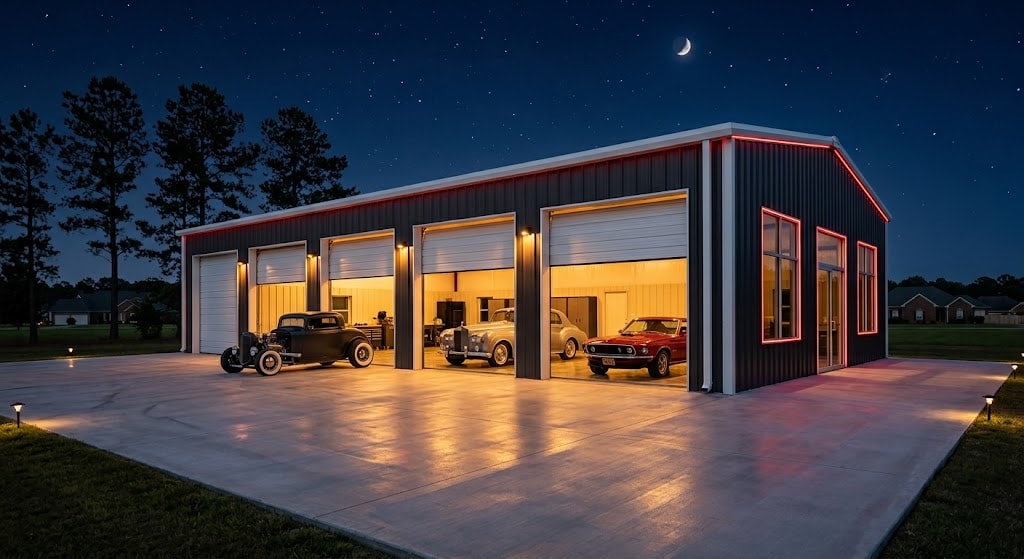
One of the most common questions I get after someone orders a metal shop building is: "What size electrical panel do I need?"
The honest answer is — it depends on what you're running. A hobbyist with a few outlets and some LED lights needs a very different setup than someone running a welder, air compressor, and HVAC unit simultaneously.
That's why I built the Workshop Electrical Panel Planner — a free interactive tool that lets you map out every circuit in your shop and get an instant panel size recommendation.
Try the Tool
👉 Open the Workshop Electrical Panel Planner →
No sign-up. No email required. Just add your circuits, adjust quantities, and see your totals update in real time.
How It Works
The planner lets you:
- Name each circuit — give it a real label like "Main Overhead LEDs" or "Welder Circuit #1"
- Set the amperage and voltage — 120V for standard outlets and lighting, 240V for heavy equipment
- Adjust quantity — one 20A circuit can serve multiple wall plugs; use quantity to count independent circuits back to the panel
- See live totals — total kilowatts, 120V load, 240V load, and a panel size recommendation update instantly
What the Panel Recommendation Means
The tool uses your total circuit load to suggest a starting panel size:
- 100A Panel — good for basic shops with lighting, outlets, and light equipment
- 200A Panel — the most common choice for a well-equipped shop with welders and compressors
- 400A Service — for heavy commercial loads; you'll want a licensed electrician involved at this level
These are starting points, not final specs. Always have a licensed electrician review your plan before purchasing equipment or pulling permits.
Planning Tips
Outlets vs. Circuits
Remember that a single 20-amp circuit can have multiple physical plug receptacles on it. When scaling your numbers, use the quantity field to represent the number of independent circuits running back to the panel — not the count of individual plastic wall plugs.
Lighting Banks
If you're using energy-efficient LEDs, you can usually put your entire shop's ceiling lights on a single 15A or 20A circuit. Use the custom name field to group them cleanly (e.g., "Main Overhead LEDs").
240V Equipment
Every 240V circuit takes up two slots on your breaker panel bus. A 50A welder circuit, for example, uses a double-pole breaker — so factor that into your panel slot count, not just your amperage total.
The 80% Rule
The National Electrical Code (NEC) recommends that continuous loads don't exceed 80% of a circuit's rated capacity. When sizing your panel, build in headroom — a 200A panel running at 160A continuous is properly loaded; one running at 195A is asking for trouble.
Ready to Build?
Once you've mapped out your electrical needs, the next step is getting the right building around it. The size of your shop, the placement of doors and windows, and the ceiling height all affect how your electrical layout works in practice.
Get a free quote on your metal shop building →
Sean can help you think through the layout, size the structure to fit your workflow, and make sure the building is ready for the electrical work your contractor will need to do.
Explore Topics
Written by
Sean Duncan
Content creator and writer sharing insights and stories.
